Green Theatre
TAHI New Zealand Festival of Solo Performance is committed to working towards environmental sustainability and using the festival as a platform to promote more sustainable practices within the arts sector.
Through Green Theatre, we aim to reduce our environmental impact while supporting artists, audiences, and partners to engage with sustainability in practical and achievable ways.
Our approach to Green Theatre focuses on practical actions across key areas of festival delivery.
This commitment is reflected through a set of key initiatives outlined below, which focus on reducing environmental impact across areas such as transport, digital delivery, consumables, sourcing, and communication.
We also support artists to engage with these principles through our Artist Sustainability Guide, which provides practical guidance on considering sustainability throughout the development and presentation of their work.
Our Sustainability Initiatives:
-
We encourage audiences, artists and staff members to use public transport when possible - please refer to Metlink for public transport options
When public transport is not available, we encourage carpooling within our team
-
Our programmes and tickets are available via QR code to minimise printing
-
Our technical team is using reusable consumables where possible. For example, using velcro straps instead of gaffer tape, or mats to cover cables rather than taping them down.
We are working on sharing technical resources across all programming.
-
Our technical team is using reusable consumables where possible. For example, using velcro straps instead of gaffer tape, or mats to cover cables rather than taping them down.
We are working on sharing technical resources across all programming.
-
We will communicate successes, results and resources with our partners, including other festivals.
Creative Responses to Sustainability
Sustainability is more than an aspiration – it's embedded in the way we create, collaborate and deliver the festival.
Our work was featured in the ASEF Green Guide for Aotearoa NZ’s Creative Responses to Sustainability magazine 2026, recognising TAHI's leadership in championing practical, values-led sustainability within the performing arts sector.
Read the full article to learn more about our approach and the steps we're taking to reduce our environmental impact while supporting artists to do the same.
→ Read the article (page 58-59)
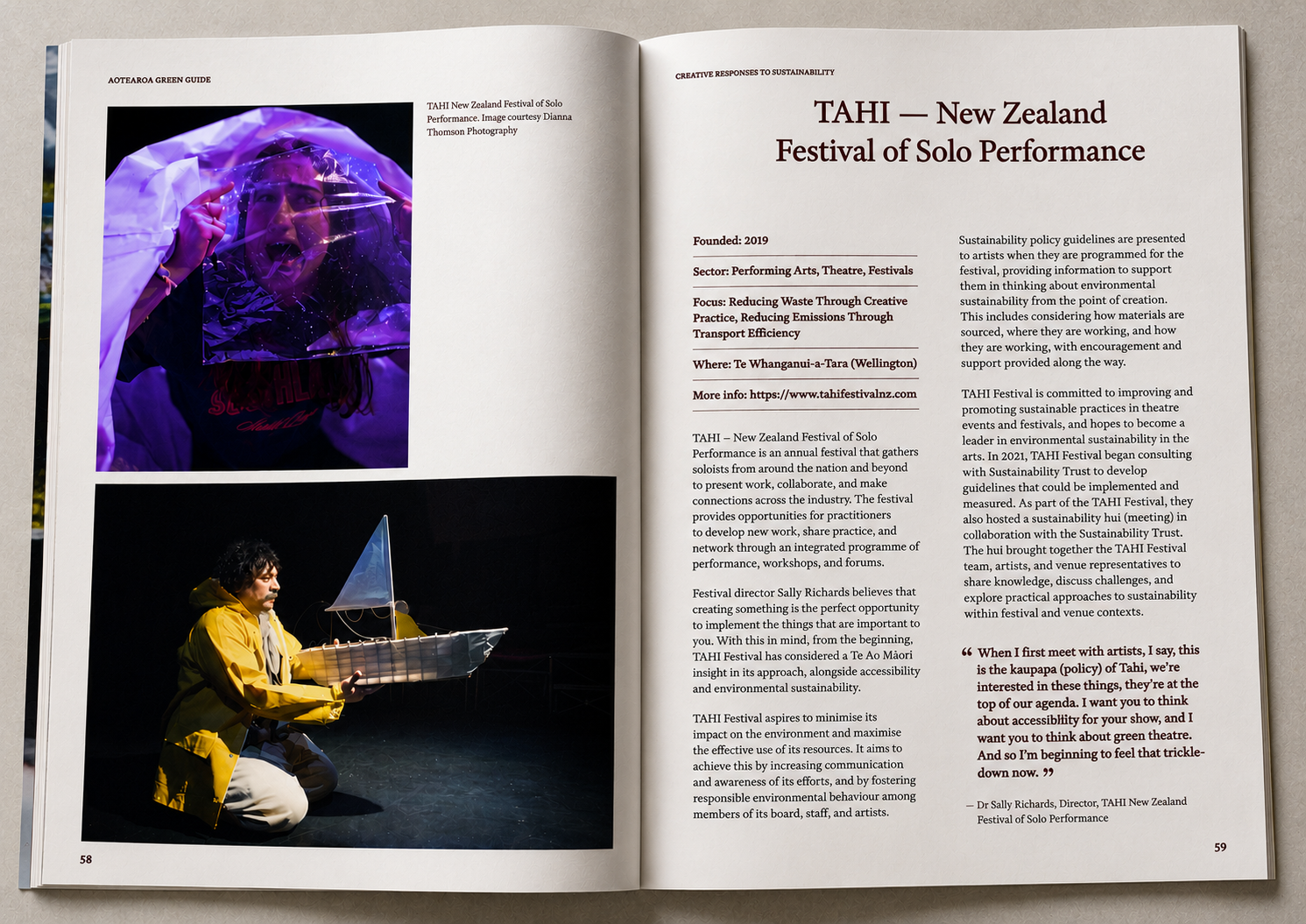
Article featuring TAHI NZ Festival of Solo Performance in Creative Responses to Sustainability - ASEF Green Guide for Aotearoa NZ 2026.
In 2023, we hosted a Green Theatre panel at the Playmarket office in Aotearoa, bringing together artists and sector partners to discuss sustainable theatre practices, tools, and ways to reduce environmental impact.
The conversation explored practical approaches to green theatre, including tracking carbon footprints and embedding sustainability into creative and production processes. You can watch the recorded discussion below.
Green Theatre Panel
Speakers included Sally Richards (Festival Director), Hannah Smith (Trick of the Light Theatre Company), Ralph McCubbin Howell (Trick of the Light Theatre Company), Sarah Mead (Wellington City Council), and Kena Duignan (Wellington City Council).
Sustainable Practice
TAHI – New Zealand Festival of Solo Performance is committed to improving and promoting sustainable practice across theatre events and festivals. In 2021, we began working with the Sustainability Trust to develop practical guidelines that support more sustainable ways of working and allow us to reflect on and measure our progress over time.
In 2022, we hosted a Sustainability Hui in collaboration with the Sustainability Trust as part of the TAHI Festival. The hui brought together the TAHI team, artists, and venue representatives to share knowledge, discuss challenges, and explore practical approaches to sustainability within festival and venue contexts.
The session emphasised collaboration and learning, recognising that improving sustainability is an ongoing process. Insights from the hui continue to inform TAHI’s approach to sustainable practice across future festivals and activities.
Greenwashing: when the sustainability of a product is exaggerated or falsely represented.
Environmental footprint: the effect that a person, item, or company has on the environment.
Sustainable: the capacity to endure in a relatively ongoing way – in this context, whether humans can continue to co-exist with the natural environment.
Procurement: the action of obtaining or buying something.
Carbon offsetting: compensating for carbon dioxide emissions by participating (usually monetarily) in schemes that make equivalent reductions of carbon dioxide.
Glossary of useful terms
In partnership with Sustainability Trust